
The Malbim, Rabbi Meir Leibush Weiser (1809–1879): biography and commentaries
Read aloud with your device’s voice.
Rabbi Meir Leibush ben Yechiel Michel Weiser (מלבי״ם), the Malbim, was a rabbi, Hebrew grammarian and Bible commentator of the 19th century. “Malbim” is an acronym of his name, which he used as a surname in his publications. He was born on March 7, 1809 in Volochysk, in Volhynia, and died in Kiev on September 18, 1879, on Rosh Hashanah 5640, on his way to Kremenchuk, where he had been called as rabbi.
Quick facts
| Name | Rabbi Meir Leibush ben Yechiel Michel Weiser. Acronym: Malbim |
| Born | March 7, 1809, in Volochysk |
| Died | September 18, 1879, in Kiev |
| Posts | Rabbi of Wreschen, Kempen, Bucharest, Lunshitz, Kherson, Mogilev and Königsberg |
| Works | HaTorah VeHaMitzvah, Mikra’ei Kodesh, Artzot HaChaim |
His life and posts
He was orphaned young and raised by his stepfather, Rabbi Leib of Volochysk. At fourteen he married and soon after divorced.
- 1838–1845: rabbi of Wreschen (Września).
- 1845–1859: rabbi of Kempen (Kępno), where he was known as the “Maggid of Kempen.”
- 1859: chief rabbi of Bucharest. He defended strict observance against the modernizers, and opposed the choir and the organ of the Coral Temple.
- Afterward: Lunshitz (Łęczyca, 1866), Kherson, Mogilev (1870, from which the governor forced him to leave) and Königsberg. In 1879 he was considered for Vilna, but the governor prevented the election, and he turned down an offer to lead the Orthodox Jews of New York.
The conflict in Bucharest
His opponents, among them slaughterers and judges annoyed by his strict supervision, made frequent complaints which almost led to his imprisonment. Sir Moses Montefiore obtained his release on condition that he leave Romania. The source does not fully reconcile the versions: the text speaks of their almost succeeding, and a note mentions a “brief imprisonment on a false accusation.”
His method
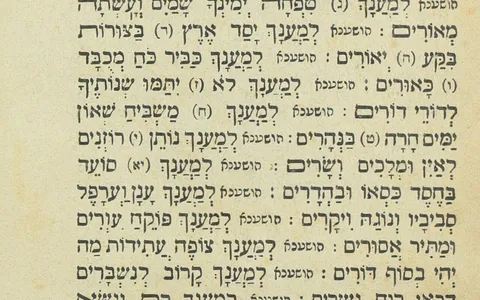
His central principle is that the Tanakh contains no true synonyms: each apparent repetition expresses a different idea. In Ayelet HaShachar he formulated 613 grammatical rules to justify halachic midrash. His commentaries combine traditional Hebrew learning with philosophy and science, and his question-and-answer style has been compared with that of Abravanel.
His works
- Artzot HaChaim (Breslau, 1837): commentary and novellae on the Orach Chaim, his first major work, published at twenty-five.
- HaTorah VeHaMitzvah (Warsaw, 1874–1880): commentary on the Pentateuch and halachic midrash, which includes Ayelet HaShachar.
- Mikra’ei Kodesh (1874): commentary on the Prophets and the Writings.
- Mashal UMelitzah (Paris, 1867): a satire in verse against hypocrisy.
The source calls his Bible commentary “one of the monumental achievements of Jewish learning of his age.”
Frequently asked questions
What does Malbim mean?
It is an acronym of Meir Leibush ben Yechiel Michel (מלבי״ם).
Where did he die?
In Kiev, in 1879, on his way to Kremenchuk.
What is his central idea as a commentator?
That in the Tanakh there are no synonyms: each term expresses a nuance of its own.
News from Ancient Gate Press
We will let you know about new books, samples and news from the press. No spam.
Sources
- Meir Leibush Malbim, reference article (English Wikipedia) and the sources it cites