
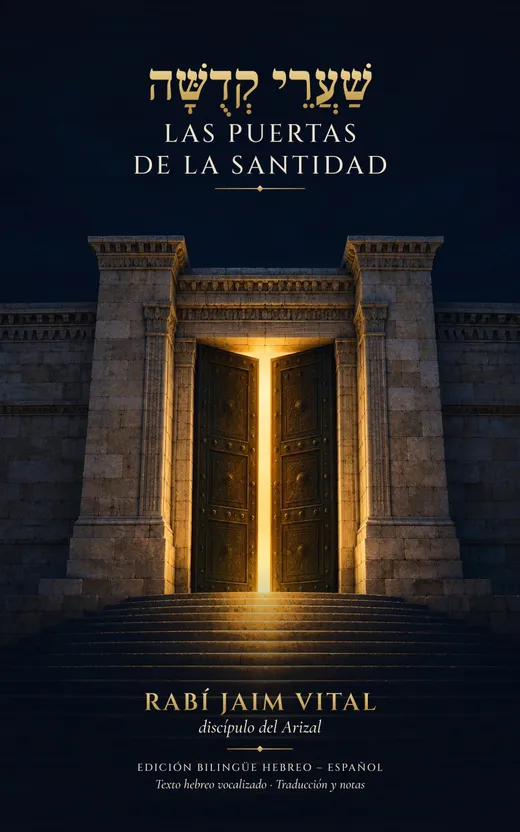
Kabbalah · Bilingual Hebrew–Spanish edition
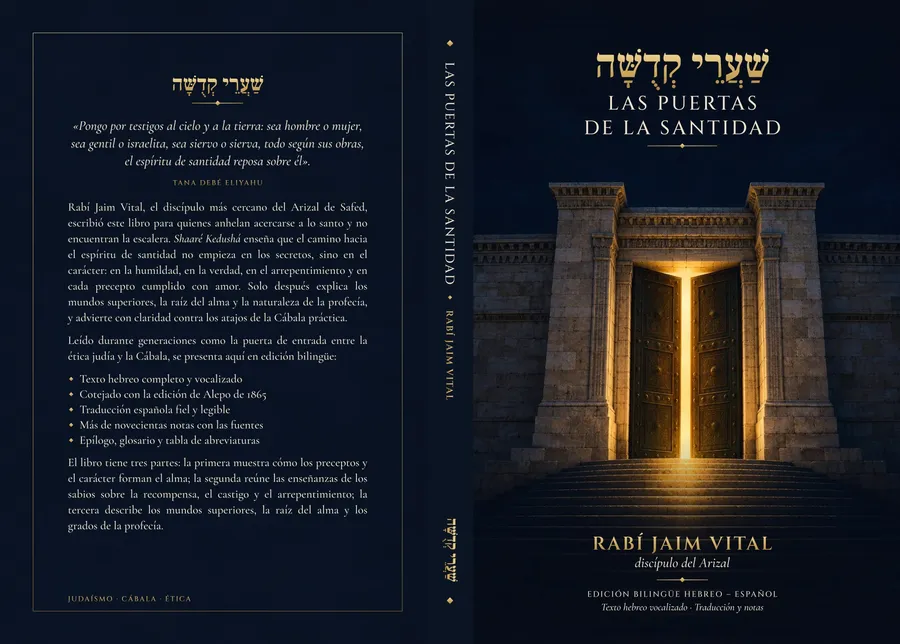
The Gates of Holiness
שַׁעֲרֵי קְדֻשָּׁה
Based on the teachings of the Arizal
- Kindle (ebook) · US$9.99United StatesSpainMexico
- Paperback · US$19.99 · coming soon
- Hardcover · US$29.99 · coming soon
Available on Amazon
Read a free sample (20 pages, PDF)
- Format
- Kindle ebook; 6 × 9 inch paperback, coming soon
- Edition
- First edition, October 2026
- Language
- Hebrew and Spanish. This edition has no English translation.
- Ebook ASIN
- B0HN5VG33W
- Text
- Hebrew with full vocalization (nikud) and a Spanish translation
- Notes
- More than nine hundred footnotes
- Structure
- The author’s introduction and three printed parts, with 22 gates
- Material
- Translator’s note, abbreviations, epilogue, about the author and glossary
- Audience
- Adults
- Publisher
- Ancient Gate Press
About this book
Rabbi Chaim Vital, the chief disciple of the Arizal, opens his book with an observation: he has seen “men of elevation” who long to ascend, but “the ladder has been hidden from their eyes.” They search the ancient books for a way to draw near to what is holy, and they do not find it. Shaarei Kedusha (“The Gates of Holiness”) is his answer, and he gives it in writing, rung by rung.
The book traces the path in three parts. It begins with the harm done by sins and by bad character traits, and with the levels of the tzaddik and the hasid. It goes on to rebukes, punishment and reward, and to repentance. Only afterward, in the Third Part, does it speak of the higher worlds, the soul and prophecy. The order is no accident, and it is the thesis of the book: the spirit of holiness is not forced from outside, but is the natural consequence of a purified soul.
A warning and a promise
Shaarei Kedusha contains one of the clearest warnings in kabbalistic literature against so-called “practical Kabbalah”: conjurations, Names used to force angels, practices that promise results without demanding transformation. The author knew it well, and that is why he does not offer it.
Alongside the warning there is a promise, perhaps the most quoted line of the book: the door is not closed to anyone, only to shortcuts.
This edition
Ancient Gate Press presents the work with the vocalized Hebrew text, alternating with the Spanish translation and accompanied by notes, so that the Spanish-speaking reader may climb the ladder with the original in front of them and with the help needed not to stumble. The text of this edition is Hebrew and Spanish; there is no English translation. The work was printed in three parts; the fourth, on practices, was never printed, and the edition explains this in a printer’s note.
Who it is for
- Readers of Spanish who seek an authentic spiritual life and do not know where to begin.
- Readers who want to read the Hebrew text with the translation in front of them, without giving up either.
- Students of Jewish ethics (mussar) who want to see how it joins with Kabbalah in a single work.
- Readers who know Rabbi Chaim Vital through the Etz Chaim and want to read his most accessible book.
A ladder in 3 stages
22 gates spread across 3 printed parts, in addition to the author’s introduction.
- Part FirstThe path of piety and separationבְּהַנְהָגַת דֶּרֶךְ הַחֲסִידוּת וְהַפְּרִישׁוּתThe foundations. What harms the soul, why character weighs more than sins, and what distinguishes the tzaddik from the hasid.6 gates
- Part SecondRebukes, punishment and rewardבְּתוֹכָחוֹת וּבְבֵאוּר הָעֹנֶשׁ וְהַשָּׂכָרThe longest and most severe part, written with the frankness of the sages. Its last gate is devoted to repentance.8 gates
- Part ThirdHow to attain the spirit of holinessבְּהַנְהָגַת הַשָּׂגַת רוּחַ הַקֹּדֶשׁWhy everything before was necessary. Man, the worlds and prophecy, and what path remains open in our age.8 gates
Detailed contents
The author’s introduction (הַקְדָּמָה). The “hidden ladder” of the men of elevation, the warning about those who conjured angels, and the plan of the book.
The foundations. What harms the soul, why character weighs more than sins, and what distinguishes the tzaddik from the hasid.
- The harm done by sins גֹּדֶל הַפְּגָם עַל יְדֵי חַטֹּאת הָאָדָם The body is the garment of the soul, and the soul has 248 limbs and 365 spiritual sinews that correspond to the commandments. Every transgression, or every commandment left undone, leaves its wound in the corresponding limb.
- The harm done by bad character traits הַפְּגָם הַנִּמְשָׁךְ עַל יְדֵי מִדּוֹת הַמְגֻנּוֹת Character traits are not among the 613 commandments, but they are their preparation and their root. That is why the author considers them far graver than the transgressions themselves.
- Tzaddik and hasid בֵּאוּר שֵׁם צַדִּיק אוֹ חָסִיד What both titles mean and how each level is reached in practice, from fulfilling the 613 commandments to the point where good character is no longer a struggle but a full possession.
- The level of the tzaddik מַדְרֵגַת הַצַּדִּיק The positive commandments that can be fulfilled in our time, arranged according to Maimonides and completed with other commentators and with the Zohar, in five groups according to when and how they arise.
- The level of the hasid מַדְרֵגַת הֶחָסִיד The gravest traits (pride, anger, resentment, sadness, envy, greed) and their opposites, set out so that one may always keep them before one’s eyes.
- The conduct of the hasidim הַנְהָגַת הַחֲסִידִים A practical summary of everything above, in the form of a daily order for the hasid. It begins at bedtime, with the examination of one’s deeds and the Shema, and continues on rising after midnight.
From the book
רָאִיתִי בְּנֵי עֲלִיָּה וְהֵם מוּעָטִים, מִשְׁתּוֹקְקִים לַעֲלוֹת, וְהַסֻּלָּם נִתְעַלֵּם מֵעֵינֵיהֶם
“I have seen the men of elevation, and they are few. They long to ascend, but the ladder has been hidden from their eyes.”
“I shall open, with great difficulty, the gates of holiness, only as the eye of a needle, and whoever is worthy will merit to enter the innermost chamber.”
“…bad character traits are far, far graver than the transgressions themselves.”
“I call heaven and earth to witness against me: whether man or woman, whether gentile or Israelite, whether manservant or maidservant, everything according to their deeds, the spirit of holiness rests upon them.”
About this edition
Hebrew with full vocalization
All the Hebrew text carries nikud, following traditional spelling (ktiv chaser). Biblical quotations follow the vocalization of the Tanakh.
A cross-checked base text
The text of the common editions is used, checked against the Aleppo edition of 1865. When the latter clearly corrects a misprint or an omission, its reading is adopted and noted in a footnote.
More than nine hundred notes
They are numbered anew in each gate. They give the sources (Scripture, Talmud, Midrash, Zohar), explain whatever the reader may need, and account for every decision about the text.
Faithful to the Hebrew, in natural Spanish
The Hebrew syntax is not copied, nor is the author embellished. Words added so that a sentence can be understood are placed in square brackets.
Terms left untranslated, with a glossary
Shechinah, sefirot, klipot, tzaddik, hasid, teshuvah, Havayah and others are left in italics because any translation would impoverish them, and they are explained in the glossary.
Sephardic transliteration
Following Spanish orthography in the Spanish text, that is, j for ח, ts for צ and gu before e or i for ג, with an accent mark where Hebrew pronunciation calls for one.
Respect for the divine Names
The four-letter Name is not written anywhere in the book, and G-d is written with a hyphen, so that it can be carried and studied anywhere.
The fourth part
The fourth part, on the modes of practice (shimush), was not printed. The printer noted that, since it dealt with Names, combinations of letters and hidden secrets, it was not proper to bring it to the altar of the printing press. The edition includes the introductory paragraph and the printer’s note, as the traditional editions do.
Editorial material:Translator’s note · Table of abbreviations · Epilogue · About the author · Glossary.
The author
Rabbi Chaim Vital
חיים ויטאל
1542–1620
He was born in Safed on the 1st of Cheshvan 5303 (autumn 1542), the son of a tefillin scribe from a Calabrian family. He studied Talmud with Rabbi Moshe Alshich and Kabbalah with the Ramak, and from 1570 he was a disciple of the Arizal, whose chief disciple he became. After his master’s death in 1572, he devoted more than twenty years to writing down and arranging his teaching. He died in Damascus in 1620.
- Etz Chaim, the great corpus of the Arizal’s Kabbalah
- Shaarei Kedusha, “The Gates of Holiness”
- Sefer HaChezyonot, “The Book of Visions”
Free sample
Read the first pages of the book before you buy it: 20 pages, right in your browser.
Sample of The Gates of Holiness
20 pages, to read right here, with nothing to download.
Preview
Frequently asked questions
What is Shaarei Kedusha?
It is a work of Jewish ethics (mussar) and spiritual conduct written by Rabbi Chaim Vital, chief disciple of the Arizal. It was first printed in Constantinople in 1734, and had circulated for generations before that in manuscript copies.
Who was Rabbi Chaim Vital?
He was born in Safed in 1542 and died in Damascus in 1620. He was a disciple of the Arizal (Rabbi Yitzchak Luria) and wrote down his Kabbalah in the Etz Chaim.
Why “gates”?
The work is divided into shaarim, “gates,” each devoted to one subject. The author says he will open them only “as the eye of a needle,” an allusion to the midrash that gives this publisher its name.
Do I need to know Hebrew to read it?
No. Each block of vocalized Hebrew is accompanied by its Spanish translation, with notes that give the source of the quotations and explain whatever the reader may need, and with a glossary at the end. The translation is in Spanish; there is no English translation of this edition.
Is it a book of practical Kabbalah?
No. The author himself warns against conjurations and against using the Names to force angels, and presents holiness as the fruit of work on conduct and character, not of a technique.
Is it a difficult book?
The first two parts speak of things any reader can understand, such as the harm of sin, pride, anger, sadness, charity, Shabbat and repentance. The Third Part is denser, because it deals with the higher worlds, the soul and prophecy, and the notes and the glossary are there to help with it.
Where is it best to begin?
At the beginning. The work is conceived as a ladder, and its most important part is not the last but the first.
Why is the fourth part missing?
It was announced as a treatise on the modes of unifications (yichudim), but it was never copied or printed. The edition keeps the introductory paragraph and the printer’s note.
What is the difference between a tzaddik and a hasid?
The tzaddik is one who fulfills everything that is asked of him. The hasid goes further, out of love, and makes good character a full possession. Gates three, four and five of the First Part develop this in detail.