Rabbi Nachman of Breslov (1772–1810): biography, works and teachings
Rabbi Nachman of Breslov (נחמן מברסלב) was a Hasidic master, a great-grandson of the Baal Shem Tov. He was born on the 1st of Nisan 5532 (April 4, 1772) in Mezhybozh and died on the 18th of Tishrei 5571 (October 16, 1810) in Uman, at the age of thirty-eight. In a short life he left a body of work and a movement that are still alive.
Quick facts
| Name | Rabbi Nachman, son of Simcha and Feiga. Known as Rebbe Nachman of Breslov |
| Born | 1 Nisan 5532 (April 4, 1772), in Mezhybozh |
| Died | 18 Tishrei 5571 (October 16, 1810), in Uman |
| Chief disciple | Rabbi Natan Sternhartz (Natan of Breslov) |
| Main works | Likutei Moharan, Sippurei Ma’asiyot, Sefer HaMiddot, Sichot HaRan |
Family
He was a great-grandson of the Baal Shem Tov through his mother, Feiga, daughter of Adil. His father, Simcha, was a son of Rabbi Nachman of Horodenka, a disciple of the Besht, in whose honor he was named. At thirteen he married Sashia, daughter of Rabbi Ephraim of Ossatin; they had six daughters and two sons. Two daughters died in infancy and both sons died before the age of two. Sashia died of tuberculosis in June 1807.
The pilgrimage to the Land of Israel
In 1798–1799 he traveled to the Land of Israel and visited Hasidim in Haifa, Tiberias and Safed. According to the source, his influence helped reconcile the Lithuanian and Volhynian Hasidim in Tiberias.
Moves
- Shortly before Rosh Hashanah of 1800 he moved to Zlatopol, where a large part of the Jewish population opposed his approach.
- In 1802 he moved to Breslov (Bratslav).
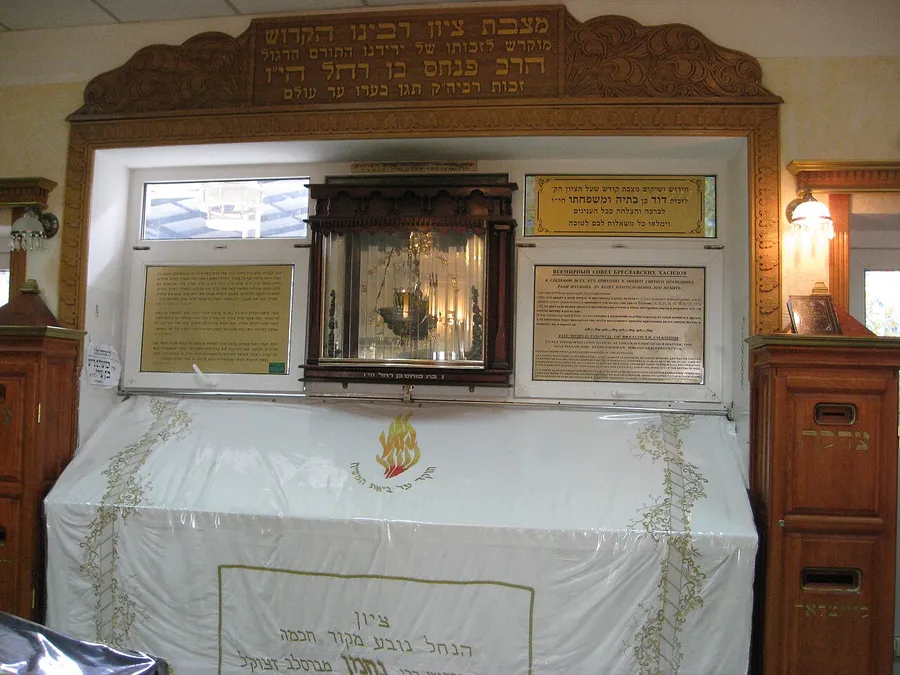
- In 1810, after a fire destroyed his house, he was invited to Uman. According to the source, he chose that city also to be near the graves of the Jews killed in the massacre of 1768 and to be buried among them.
His works
- Likutei Moharan: Hasidic interpretations of Tanakh, Talmud, Midrash and Zohar. It was published in three volumes between 1808 and 1815. His disciple Natan Sternhartz transcribed and published it.
- Sippurei Ma’asiyot: thirteen tales in Yiddish, later translated into Hebrew (1815 or 1816, according to the source).
- Sefer HaMiddot: practical maxims arranged alphabetically by topic, published around 1821.
- Sichot HaRan: 308 short talks.
- Tikkun HaKlali: a series of ten Psalms recited in different situations, with commentary by Natan.
Teachings
- Hitbodedut: a daily, private conversation with G-d, in one’s own words, traditionally outdoors, like someone speaking with a close friend.
- Joy: he taught that being joyful is a commandment of great importance, and stressed faith, simplicity and joy, including song and dance.
- The tzaddik: he rejected hereditary dynasties and taught that any Jew can become a tzaddik.
- The narrow bridge: the teaching that, when crossing a very narrow bridge, the main thing is not to be afraid.
The burned manuscripts
Around 1808 he burned all copies of Sefer HaGanuz (“the hidden book”) and of Sefer HaNisraf (“the burned book”). According to the source, he believed that his tuberculosis was a punishment for having written a book. Natan never came to understand HaNisraf, but remembered that it dealt with hospitality.
The Breslov movement
After his death, Natan Sternhartz began an annual pilgrimage to his grave on Rosh Hashanah, which according to the source drew thousands until 1917, was kept up in secret under communism and resumed after 1989; in 2008 it is said to have gathered some twenty-five thousand participants.
Frequently asked questions
Who was Rebbe Nachman?
A Hasidic master, a great-grandson of the Baal Shem Tov, founder of the Breslov current.
What is hitbodedut?
A personal, daily conversation with G-d, in one’s own language, alone.
Where is he buried?
In Uman, in Ukraine, where thousands of pilgrims gather every year on Rosh Hashanah.
What became of his books?
He left published works, mainly through his disciple Natan, and burned others before he died.
Sources
- Nachman of Breslov, reference article (English Wikipedia) and the sources it cites