
The Kuzari of Rabbi Yehuda Halevi: what it is, structure and arguments
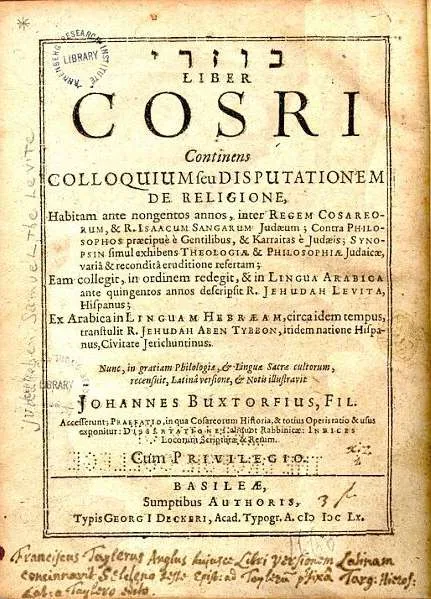
The Kuzari (הכוזרי) is the best-known philosophical work of Rabbi Yehuda Halevi. It was composed in Arabic, finished around 1140 (the Hebrew year 4900, 1139–1140), and takes the form of a dialogue between a rabbi and the king of the Khazars, who asks about Judaism in comparison with Christianity and Islam.
Quick facts
| Original title | Kitab al-Hujja wa-l-Dalil fi Nasr al-Din al-Dhalil, “Book of Refutation and Proof in Defense of the Despised Religion” |
| Author | Rabbi Yehuda Halevi |
| Completed | Around 1140 (Hebrew year 4900) |
| Original language | Judeo-Arabic |
| Standard Hebrew translation | Rabbi Yehuda ibn Tibbon, 12th century |
| First printed edition | Fano, 1506 |
Structure
It is divided into five discourses (maamarim), written as a dialogue between the rabbi and the king of the Khazars. The king evaluates each position and ends up embracing Judaism. The first discourse defends creation from nothing, although it acknowledges that the eternity of matter is not absolutely opposed to Jewish ideas; the fifth criticizes Aristotelian and other systems.
Its central arguments
- Revelation versus natural religion: revealed religion is superior to natural religion, and G-d’s miracles on behalf of Israel are the starting point, not speculative proofs of the existence of G-d.
- The people, the Torah and the Land: the Jews are the keepers of a written history, and the people of Israel, the Torah and the Land of Israel are presented as unique.
- Critique of philosophy: one comes to G-d through tradition and devotion more than through philosophical speculation.
Did the conversion of the Khazars happen?
The work is set in the conversion of the Khazars to Judaism. The historicity of that conversion is disputed: the Khazar correspondence and other documents are cited as evidence of a conversion of the royalty and the nobility, but Moshe Gil and Shaul Stampfer question it. Its extent is unknown.
Translations and editions
The main Hebrew translation is that of Rabbi Yehuda ibn Tibbon, from the 12th century; the title page of the edition dates it to 1167, in Lunel, according to the catalogs. It went through eleven printed editions, the first in Fano in 1506. Another translation, by Rabbi Yehuda ben Yitzchak Cardinal, from the early 13th century, survives only in part.
Commentaries
Six commentaries were printed in the 15th century, of which four are known, all in Hebrew: Edut LeYisrael, by Shlomo ben Menachem (lost); Kol Yehuda, by Yehuda Moscato; and those of two disciples of Shlomo ben Menachem, Yaakov ben Parisol and Netanel ben Nechemya HaKaspi. In the 20th century, Rabbi Shlomo Aviner published a four-volume commentary, and David Cohen, The Kuzari Explained, in three.
Influence
The source notes that the work shaped Jewish identity. Gershom Scholem traced a direct line from it to the kabbalistic movement, an opinion held by some scholars. It also played a part in the debates of the Haskalah.
Frequently asked questions
Who was the king of the Khazars?
A character in the dialogue, inspired by the conversion of the Khazars to Judaism, whose historicity is disputed.
How many parts does it have?
Five discourses (maamarim).
In what language was it written?
In Judeo-Arabic, and it was later translated into Hebrew and other languages.
Sources
- Kuzari, reference article (English Wikipedia) and the sources it cites
- Cross-checking of editions: Kestenbaum and Kedem catalogs (Fano, 1506); Seforim Blog