

Jewish ethics
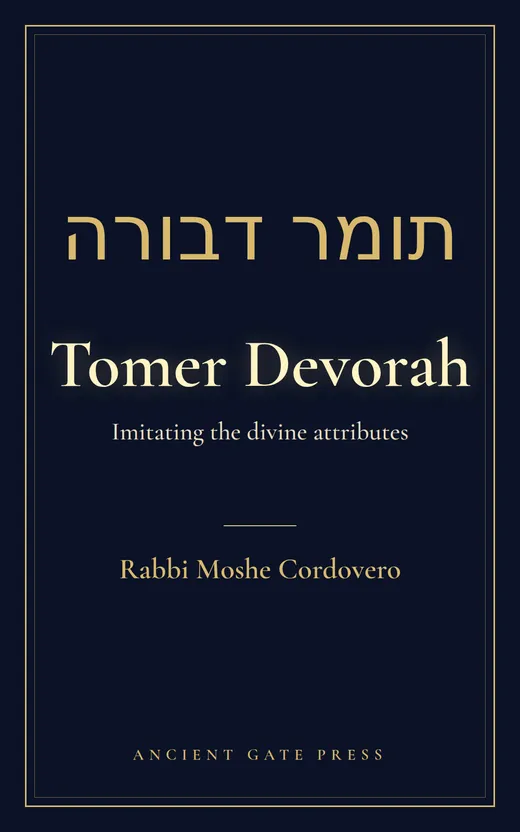
Tomer Devorah
תומר דבורה
Imitating the divine attributes
Also known as The Palm Tree of Deborah
- Coming soon
- Format
- Coming soon
- Edition
- In preparation
- Author
- Rabbi Moshe Cordovero (the Ramak), 1522–1570
- Written in
- Safed, mid-16th century
- First edition
- Venice, 1588–1589 (5349), edited by Rabbi Moshe Bassola, the author’s disciple
- Genre
- Jewish ethics (mussar) with a kabbalistic foundation
- Structure
- Ten chapters: the thirteen attributes of mercy (ch. 1–2) and one for each sefirah (ch. 3–10)
- Central theme
- Imitating the attributes of God in conduct
- Audience
- Adults
- Publisher
- Ancient Gate Press
About this book
Tomer Devorah (תומר דבורה), “The Palm Tree of Deborah,” is the shortest and most practical ethical treatise of Rabbi Moshe Cordovero, the Ramak, the great master of Kabbalah in 16th-century Safed. Its thesis fits in one sentence, and it is the book’s first: man must resemble his Creator, not in the shape of his body but in what he does. “What good is it to resemble the supernal form in the shape of one’s limbs, if in one’s actions one does not resemble one’s Creator?”
The name comes from the book of Judges: the prophetess Deborah judged Israel “under the palm tree of Deborah” (Judges 4:5). The Ramak reads the palm tree as an image of the flow of divine mercy along the central axis of the sefirot.
What it teaches
Each chapter takes an attribute with which God conducts the world and asks how it is reflected in a concrete human conduct. Whoever forgives because God forgives, whoever gives without expecting anything in return because God gives, whoever teaches because wisdom reaches everyone, imitates the Creator in what matters. And the Ramak adds an idea that gives the effort meaning: as a person conducts himself below, so the corresponding quality is opened for him above.
That is why the work is not a kabbalistic theory but a book of conduct, which fits within the mussar movement, the work on character trait by trait. You need not master the sefirot: the chapters name them to organize the topic, but the content is practical.
The ten chapters
- The thirteen attributes of mercy (Keter). Based on Micah 7:18–20 (“Who is a God like You, who pardons iniquity…”), the Ramak develops thirteen ways of acting, one for each attribute: bearing an offense, overlooking a fault, holding no grudge, forgiving and wishing good even to the one who has offended. It is the best-known chapter, and the one to start with.
- Other qualities that resemble Keter. The one that includes all is humility. Advice for cultivating it follows, along with guidance for thought, sight, hearing and speech, so that no part of the body strays from the good.
- Chochmah, wisdom. Supernal wisdom extends to all things, and so should a person’s: one face turned toward the Creator, in seclusion, and another turned toward people, to teach and benefit them.
- Binah, understanding. Binah is teshuvah, return: “nothing is as precious, for it repairs every flaw.” Whoever thinks of returning every day of his life makes his whole life a return.
- Chesed, kindness. What is essential is to love Hashem with total love, in good times and in trial, and from kindness between people one learns kindness toward the Creator.
- Gevurah, severity. The evil inclination awakens the forces of severity, so the chapter deals with self-mastery and how objectionable anger is.
- Tiferet, beauty. Beauty is the study of Torah, and the danger is to be proud of it: whoever humbles himself before the Torah and teaches his students with affection makes the learning descend and be communicated.
- Netzach, Hod and Yesod. Supporting those who study Torah, with means and with deeds, so that they are not interrupted, and honoring them; and the rectifications specific to Yesod.
- Malchut, kingship. Standing before the Creator as a poor man pleading, accepting exile, the fear of Hashem, conduct with one’s wife and the yoke of the commandments.
- Conduct at each moment. Following a teaching of the Zohar, a person should know which sefirah rules at each hour and bind himself to it: at night, with Malchut, accepting the yoke of the kingdom before sleeping and rising at midnight; by day, with the qualities of the three patriarchs.
A book with weighty approbations
The book was first printed in Venice, around 1588–1589, some twenty years after the Ramak’s death, by his disciple Rabbi Moshe Bassola, who took it from a manuscript kept by Rabbi Menachem Azaria of Fano. In the 1621 Prague edition, the Shelah HaKadosh (Rabbi Yeshayahu Horowitz) wrote his approbation: “It is entirely fear of Heaven and acceptance of the yoke of His kingdom,” and added that it is a commandment for everyone to acquire the book. Rabbi Avraham Azulai included it in full in his Chesed LeAvraham, and in 1858 Rabbi Yisrael Salanter, founder of the mussar movement, reprinted it with his Iggeret HaMussar (“Letter on Mussar”).
How to read it
- Start with the first chapter. It holds the core of the work and needs very little background.
- Read it slowly and often. It is a short book, meant to be returned to rather than read straight through: one chapter, and one quality to put into practice during the week.
To get to know the work before reading it, see the guide to Tomer Devorah. And if you are interested in mussar with kabbalistic roots, see also The Gates of Holiness, by Rabbi Chaim Vital, a disciple of the Ramak.
News from Ancient Gate Press
We will let you know about new books, samples and news from the press. No spam.
Who it is for
- Anyone approaching Kabbalah who wants a short, practical way in, without formulas or mystery.
- Students of mussar looking for the foundation of the character traits in the sefirot.
- Anyone who wants to know what “imitating God” means in practice: forgiving, giving, teaching, being humble.
From the book
האדם ראוי שיתדמה לקונו… שהרי עיקר הצלם והדמות העליון הן פעולותיו
“A person should resemble his Creator… for the essence of the supernal image and likeness is His actions.”
כפי מה שיתנהג כך משפיע מלמעלה וגורם שאותה המדה תאיר בעולם
“As a person conducts himself below, so the corresponding quality is opened for him above, and it makes that quality shine in the world.”
הכוללת הכל היא מדת הענוה
“The one that includes all is the quality of humility.”
שאין דבר חשוב כמוה, מפני שהיא מתקנת כל פגם
“To return in teshuvah: nothing is as precious, for it repairs every flaw.”
עיקר כניסת האדם אל סוד החסד הוא לאהוב את ה׳ תכלית אהבה
“A person’s entry into the secret of Chesed is to love Hashem with total love.”
וצריך האדם בזה להתנהג כפי הזמן, רוצה לומר לדעת איזו ספירה שולטת ולהתקשר בה
“A person must conduct himself according to the time: to know which sefirah rules and to bind himself to it.”
The author
Rabbi Moshe Cordovero (the Ramak)
משה קורדובירו
1522–1570
The great systematizer of Kabbalah in 16th-century Safed and the teacher of Rabbi Chaim Vital. Before the Arizal arrived, he was the main teacher of the city’s kabbalistic circle. His Pardes Rimonim set out, for the first time in a systematic way, the world of ideas of the Zohar and of earlier kabbalists. He died in Safed in 1570.
- Pardes Rimonim, the great systematic treatise on Kabbalah
- Tomer Devorah, “The Palm Tree of Deborah”
Frequently asked questions
What is Tomer Devorah?
A short ethical treatise by Rabbi Moshe Cordovero, the Ramak, written in Safed in the mid-16th century. Its thesis: man was created in the image of God, and so he must imitate in his actions the attributes with which God conducts the world.
What does “Tomer Devorah” mean?
“The Palm Tree of Deborah.” The name comes from Judges 4:5, where the prophetess Deborah judged Israel “under the palm tree of Deborah.”
Do you need to know Kabbalah to read it?
No. It is a book about conduct: it uses the sefirot to organize the topics, but what it teaches is practical. It works as an entry point into both Kabbalah and mussar.
How many chapters does it have and what are they about?
Ten. The first sets out the thirteen attributes of mercy of Micah 7:18–20; the second, humility and other qualities; chapters 3 to 9 go through the sefirot (wisdom, understanding, kindness, severity, beauty, victory-splendor-foundation and kingship), and the tenth explains how to act at each moment of the day.
Where should I start?
With the first chapter: it holds the core of the work and needs very little background. Then read slowly, one chapter at a time, and come back to it.
What did the sages say about this book?
Rabbi Yeshayahu Horowitz, the Shelah HaKadosh, signed his approbation in the 1621 Prague edition: he says the book “is entirely fear of Heaven and acceptance of the yoke of His kingdom,” and that whoever accustoms himself to it and reads it every week or month is assured of the World to Come.