

Parashat Vayera (Genesis 18–22): Summary and Commentary
Read aloud with your device’s voice.
Summary
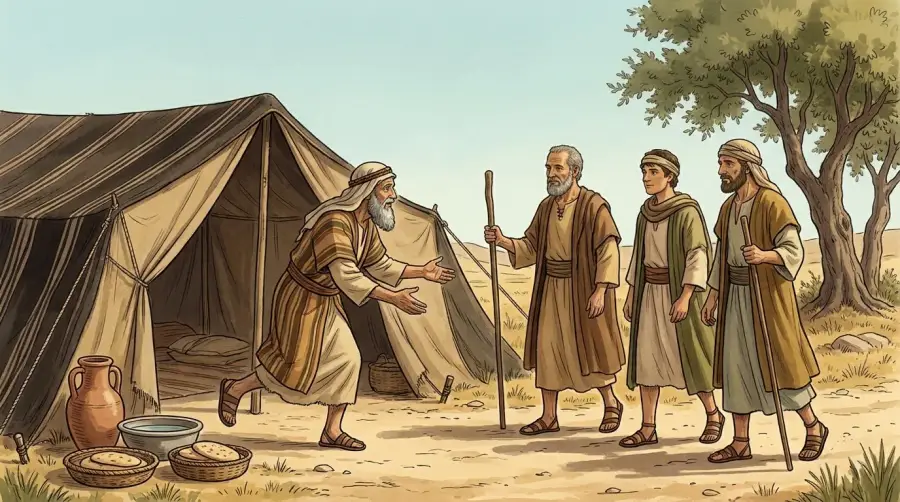
Vayera begins with a very simple scene: Abraham is sitting at the entrance of his tent, in the heat of the day, and sees three men approaching. He runs to meet them, offers them water, rest and food, and one of them tells him that in a year Sarah will have a son. Sarah hears it from the tent and laughs (ch. 18).
Then Hashem tells Abraham what He is going to do to Sodom, and Abraham, instead of keeping silent, intercedes: what if there were fifty righteous? And forty-five? He keeps lowering the number down to ten (18:23-32). Even so, Sodom and Gomorrah are destroyed. Lot is saved, but his wife looks back and is turned into a pillar of salt (ch. 19).
Later, in Gerar, King Avimelech takes Sarah; Hashem warns him in a dream and he returns her to Abraham (ch. 20). At last Yitzchak is born, and Abraham circumcises him on the eighth day (21:1-8). Hagar and Yishmael are sent into the desert, where an angel comes to their aid (21:9-21), and Abraham and Avimelech seal a covenant at Beer Sheva (21:22-34).
And at the end comes the hardest test: Abraham is asked to offer Yitzchak on one of the mountains in the land of Moriah. Abraham binds his son on the altar, an angel stops him, and he offers a ram in his place (ch. 22). The portion closes with a separate piece of news: the lineage of Nachor and the birth of Rivkah (22:20-24).
If one had to keep four ideas, they would be these: hospitality, intercession for others, the promise that is fulfilled, and faith put to the test.
Parashat Vayera (“and he appeared”) is the fourth portion of the book of Bereshit (Genesis 18:1–22:24) and is read on the Shabbat of October 31, 2026. It takes its name from the first sentence: “And Hashem appeared to him in the plains of Mamre” (18:1).
The tradition proposes reading each portion in four steps: what the text says, what it hints at, what the sages explain and what it conceals. Let us take them in turn.
Peshat: the simple meaning
Let us begin with what the text says, adding nothing to it. There are details that the narrative itself seems to underline.
First, who arrives. Chapter 18 opens by saying that “Hashem appeared to him,” and right away Abraham looks up and sees “three men” (18:1-2). The text calls them “men” (18:2, 18:16); when they reach Sodom, chapter 19 already speaks of “the two angels” (19:1).
Notice also how he receives them. He offers “a little water” and “a morsel of bread” (18:4-5), but he runs to prepare a tender and good calf, curds and milk (18:7-8). He says little and does much.
Then there is the laughter. Sarah laughs “within herself” (18:12) and later denies it, out of fear (18:15). When the child is born, his name, Yitzchak (“he will laugh”), keeps that laughter (21:3, 21:6).
In the negotiation over Sodom, Abraham does not ask for everything at once: he lowers the number of righteous people, from fifty to forty-five, forty, thirty, twenty and ten (18:24-32).
And at the binding, the command insists on “your son, your only one, whom you love” (22:2), and the text repeats twice that “the two of them went together” (22:6, 22:8). It is hard not to pause at those repetitions.
Remez: what the letters hint at
Remez means “hint.” Here the reading pauses on letters and numbers: on how a word, when the value of its letters is added up (gematria), coincides with another that illuminates its meaning. The great collector of these hints is the Baal HaTurim, Rabbi Yaakov ben Asher (13th–14th centuries), author of the Arba Turim. In the first two verses of Vayera he finds four.
The first is in the final letters of “Vayera eilav Hashem” (וירא אליו ה׳): together they form avah (אוה), “he desired.” As if the text were saying, in a low voice, that Hashem desired to dwell in Abraham’s tent.
The second is in the three men. “Vehineh shloshah” (והנה שלשה), “and behold, three,” adds up to 701, the same as “Elu Michael, Gavriel veRefael” (אלו מיכאל גבריאל ורפאל), “these are Michael, Gavriel and Raphael.”
The third is in the heat of the day. “Kechom hayom” (כחם היום) adds up to 129, the same as dam milah (דם מילה), “the blood of circumcision.” And zehu beGehinnom (זהו בגיהנם), “this is in Gehinnom,” adds up to 128, which with the kolel also matches. The Baal HaTurim ties it to a saying of the sages according to which Abraham sits at the entrance of Gehinnom and does not let anyone who is circumcised enter there, with one exception. (Compare Eruvin 19a, where Abraham goes down to Gehinnom and brings the circumcised out of it, with the same exception.)
The fourth is in hospitality. “Yoshev petach ha’ohel” (יושב פתח האהל), “sitting at the entrance of the tent,” adds up to 847, and “lehachnis et ha’orchim” (להכניס את האורחים), “to bring in the guests,” adds up to 846: with the kolel, they match. And “Vayera eilav” (וירא אליו), counting the number of words, adds up to 266, the same as “zeh bichvod milah niglah eilav” (זה בכבוד מילה נגלה אליו), “in honor of circumcision He was revealed to him.”
Two things should be made clear. The kolel is adding one to the total, a common convention of gematria. And these coincidences prove nothing: they suggest. Their value is that they point, by another route, to what the sages already teach: circumcision, hospitality and the presence of the Shechinah in Abraham’s tent.
Drash: the teaching of the sages and hospitality
The sages do not read this passage as a simple anecdote about good manners. The Talmud (Shabbat 127a) starts from Genesis 18:3 and teaches something surprising: that “hospitality (hachnasat orchim) is greater than receiving the face of the Presence.” The reason is that Abraham, in the middle of Hashem’s visit, asks Him to wait while he attends to the guests.
And how is that brought into everyday life? Generosity is trained in small things. A meal, a conversation, a little time for someone who arrives unannounced: that is, on an everyday scale, what Abraham does in this portion.
Sod: what is hidden
The Zohar
The Zohar pauses at the first sentence. Why does it say “and he appeared to him” and not “to Abram”? Its answer links to the previous portion: before circumcision Abraham was “closed” (atum); afterward, everything was revealed and the Presence (Shechinah) rested on him completely (Zohar I, Vayera). The covenant of circumcision inaugurates a new relationship.
On the heat of the day, the Zohar reads that “the right side shone,” the degree to which Abraham is joined. And on the three men it asks what we ask ourselves: who are they? It answers: Abraham, Yitzchak and Yaakov, from whom the lower degree is nourished (Zohar I, Vayera).
מִי הֵם שְׁלֹשָׁה אֲנָשִׁים? אֵלּוּ אַבְרָהָם יִצְחָק וְיַעֲקֹב “Who are the three men? These: Abraham, Yitzchak and Yaakov.”
It also records a tradition according to which Hashem was revealed “in the plains of Mamre” because Mamre was the one who advised Abraham to carry out the circumcision.
The sefirah: Chesed
Abraham is the model of Chesed, kindness that gives without measure: the sefirah of the right column, the right hand in the image of the body. You can see where it sits in the guide to the sefirot. The Ramak, in Tomer Devorah, proposes imitating the divine attributes as a path of ethics, and Abraham’s hospitality is the classic example of imitating divine kindness. To keep working on character, you can read Shaarei Kedusha, by Rabbi Chaim Vital.
More weekly commentary in the list of parashiot.
News from Ancient Gate Press
We will let you know about new books, samples and news from the press. No spam.
Sources
- Genesis 18:1–22:24 (text of the portion)
- Zohar I, portion Vayera, on “Vayera elav” (Gen. 18:1) and the three men (Hebrew-Aramaic text from Sefaria-Data; our translation)
- Baal HaTurim on Genesis 18:1-2 (Hebrew text; gematriot recalculated)
- Babylonian Talmud, Eruvin 19a (Abraham and the entrance to Gehinnom)
- Babylonian Talmud, Shabbat 127a (hospitality and Gen. 18:3)
- Articles on this site about the sefirot and Tomer Devorah