
Mesillat Yesharim by the Ramchal: what it is, structure and how to read it
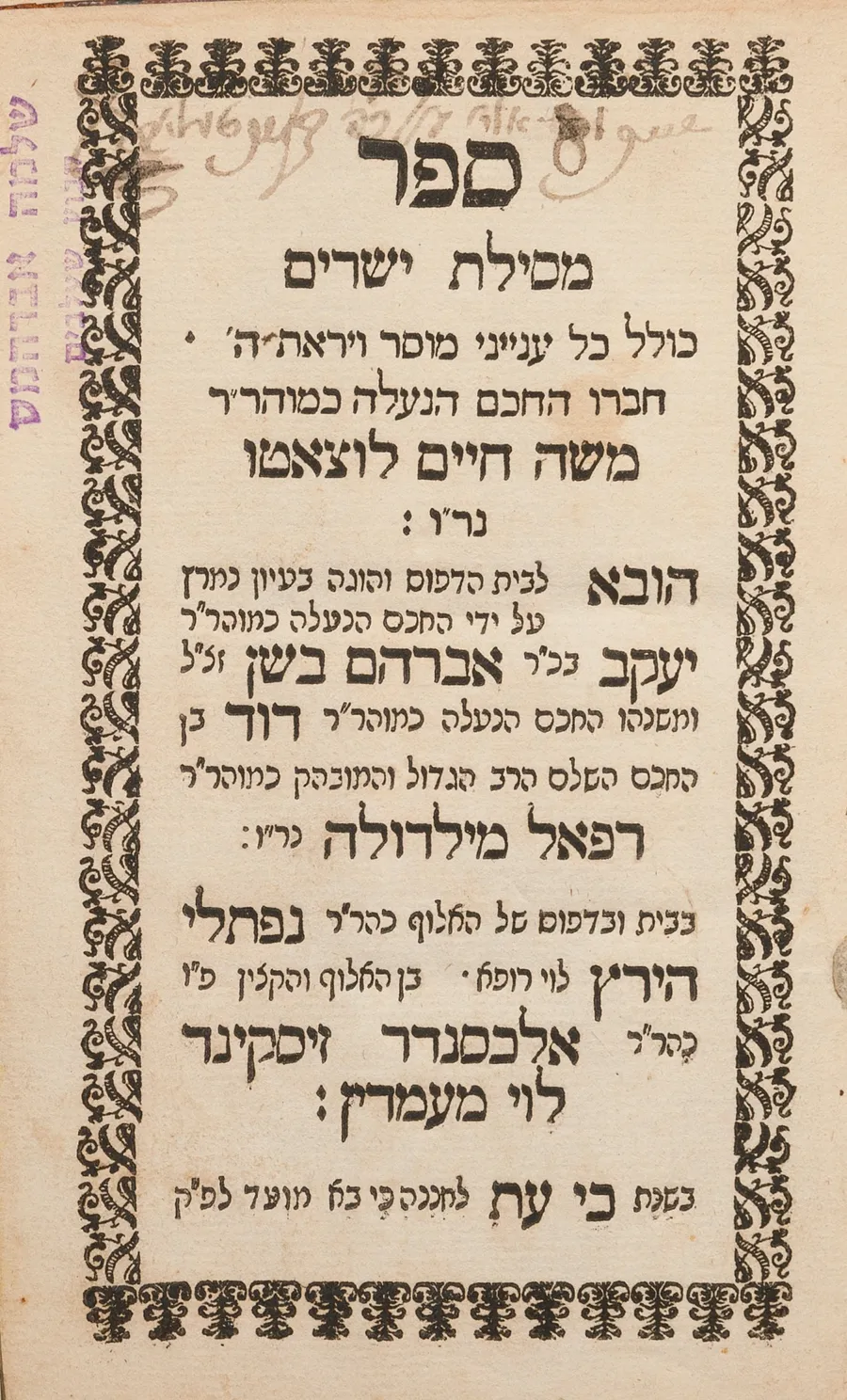
Mesillat Yesharim (מסילת ישרים), “The Path of the Just,” is the best-known book of Jewish ethics by the Ramchal, Rabbi Moshe Chaim Luzzatto. He wrote it in Amsterdam and it was published in 1740. It proposes a gradual path, in stages, from the study of the Torah to holiness.
Quick facts
| Title | Mesillat Yesharim (“The Path of the Just”) |
| Author | Rabbi Moshe Chaim Luzzatto, the Ramchal |
| Written in | Amsterdam; the oldest known manuscript is from 1738 |
| First edition | Amsterdam, 1740 |
| Genre | Jewish ethics (mussar) |
How it is built
Unlike many mussar books, which are ordered according to the list of traits the author wants to treat, Mesillat Yesharim rests on a baraita attributed to Rabbi Pinchas ben Yair (Avodah Zarah 20b). That baraita lists a ladder of attainments, so that each leads to the next. The teaching begins thus: “Torah leads to watchfulness (zehirut), watchfulness leads to diligence (zerizut)…”.
Each stage is treated in the same way: what it is, how it is acquired and what harms it.
The stages
After an introduction and a first chapter on man’s general obligation in his world, the book goes through nine stages:
- Watchfulness (zehirut)
- Diligence (zerizut)
- Cleanliness (nekiut)
- Separation (perishut)
- Purity (taharah)
- Piety (chasidut)
- Humility (anavah)
- Fear of sin (yirat chet)
- Holiness (kedushah)
The original baraita continues with the spirit of holiness and the resurrection of the dead, which the book does not develop as chapters.
A manner of writing
The oldest known manuscript takes the form of a dialogue between a sage (chacham) and a pious man (chasid). Before publication it was rewritten with a single speaker.
Its influence
- Reach: it is considered perhaps the most important text of Jewish ethics of the early modern period. It went through ten editions between 1740 and 1835.
- The Vilna Gaon: it is told that the Vilna Gaon found not a single superfluous word in the first eleven chapters and that he would have traveled to learn from the author. This is a reported testimony, not verified in the sources consulted.
- The mussar movement: Rabbi Yisrael Salanter placed it at the center of the study of mussar in the yeshivot of Eastern Europe.
- In English: Mordecai Kaplan published the first English translation with the Jewish Publication Society, in 1936.
How to read it
- From beginning to end, in order. Each stage prepares the next.
- With a pencil. It is a book to work with: each chapter proposes a practice.
- One stage at a time. The author insists that one does not advance if the previous stage is not settled.
Relation to other works
- It shares its aim with Shaarei Kedusha by Rabbi Chaim Vital, although the construction is different: see the guide to the gates.
- Another classic of mussar with a kabbalistic foundation is Tomer Devorah.
Frequently asked questions
Who wrote it?
Rabbi Moshe Chaim Luzzatto, the Ramchal, in Amsterdam.
What does the title mean?
“The Path of the Just.” Mesillah is a road, a laid-out path.
What is it based on?
On a baraita of Rabbi Pinchas ben Yair in tractate Avodah Zarah 20b, which lists a ladder of virtues.
Do I need to know Hebrew to read it?
No. Translations exist in numerous languages.
Sources
- Mesillat Yesharim, reference article (English Wikipedia) and the sources it cites
- Moshe Chaim Luzzatto, reference article (English Wikipedia)