
Sefer Yetzirah: what it is, authorship, versions and content
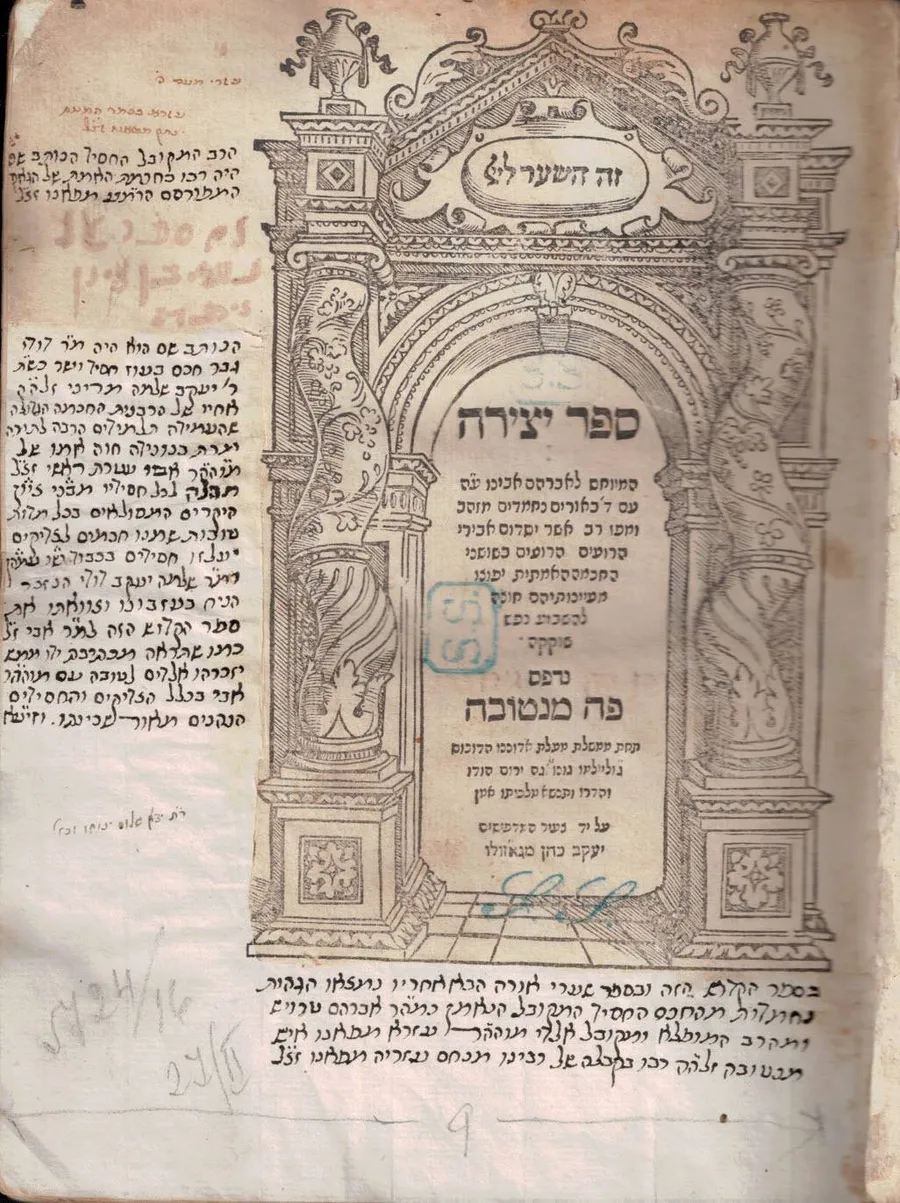
The Sefer Yetzirah (ספר יצירה), “Book of Formation” or “of Creation,” is one of the oldest and most enigmatic works of the Jewish mystical tradition. Tradition attributes it to the patriarch Abraham. It is very brief, but its influence on later Jewish thought was enormous.
Quick facts
| Title | Sefer Yetzirah (“Book of Formation”) |
| Traditional attribution | Abraham; a minority cites Rabbi Akiva |
| Date | Disputed: scholars give between the 2nd and 6th centuries; it already existed in the 10th century |
| First printed edition | Mantua, 1562 |
| Theme | Creation by thirty-two “paths of wisdom” |
Authorship
The book attributes it to Abraham: the appendix (6:15) says that Abraham received the revelation, and rabbinic authorities generally accepted it. The Ramak cites a minority opinion according to which Rabbi Akiva wrote it, or that Abraham wrote it and Rabbi Akiva edited it. Modern research has not reached a consensus on its origin.
Date
The Jewish Encyclopedia places its essential elements in the 3rd or 4th centuries; some propose the 2nd century BCE or the 2nd century of the Common Era, and most scholars date it between the 2nd and 6th centuries, although the 9th century has been argued in an Islamic context. It certainly existed in the 10th century. There is no critical edition.
Versions
- The short version, of about 1,300 words, which is the basis of the first printed edition.
- The long version, of about 2,500 words, with passages that are not in the short one.
- The Saadia version, a reorganization of the long one, with the commentary of Saadia Gaon of the 10th century, more philosophical than mystical.
- The Gra version: the Ramak produced a working text from ten manuscripts, the Arizal harmonized it with the Zohar, and the Vilna Gaon edited it anew in the 18th century. See the biographies of the Ramak, of the Arizal and of the Vilna Gaon.
Content
It describes creation through “thirty-two mysterious paths of wisdom”: the ten sefirot (numbers) and the twenty-two letters. The letters are grouped into three “mothers” (alef, mem, shin), seven “doubles” (bet, gimel, dalet, kaf, pe, resh, tav) and twelve “simples.” The three mothers correspond to air, water and fire, the seven doubles to the planets, the days and the openings of the body, and the twelve simples to the zodiac signs, the months and the organs.
The Mantua edition
It was first printed in Mantua, in 1562, by Yaakov ben Naftali of Gazolo, with the short version surrounded by commentaries, and the long version at the end. The commentaries are by Rabbi Yosef ben Shalom Ashkenazi (mistakenly attributed to Rabbi Abraham ben David of Posquières), by Rabbi Elazar of Worms, by pseudo-Saadia and by the Ramban.
Influence
The source recalls the assessment of the Jewish Encyclopedia: few works after the Talmud had as much influence on Jewish thought. It is regarded as an early link in the development of kabbalistic ideas, although its sefirot differ from those of later Kabbalah.
Frequently asked questions
Who wrote it?
Tradition attributes it to Abraham. Scholars have not reached a consensus.
What are the thirty-two paths?
The ten sefirot and the twenty-two letters of the Hebrew alphabet.
When was it printed?
In Mantua, in 1562.
Sources
- Sefer Yetzirah, reference article (English Wikipedia) and the sources it cites
- Cross-checking of the Mantua, 1562 edition: auction catalogs and bibliography